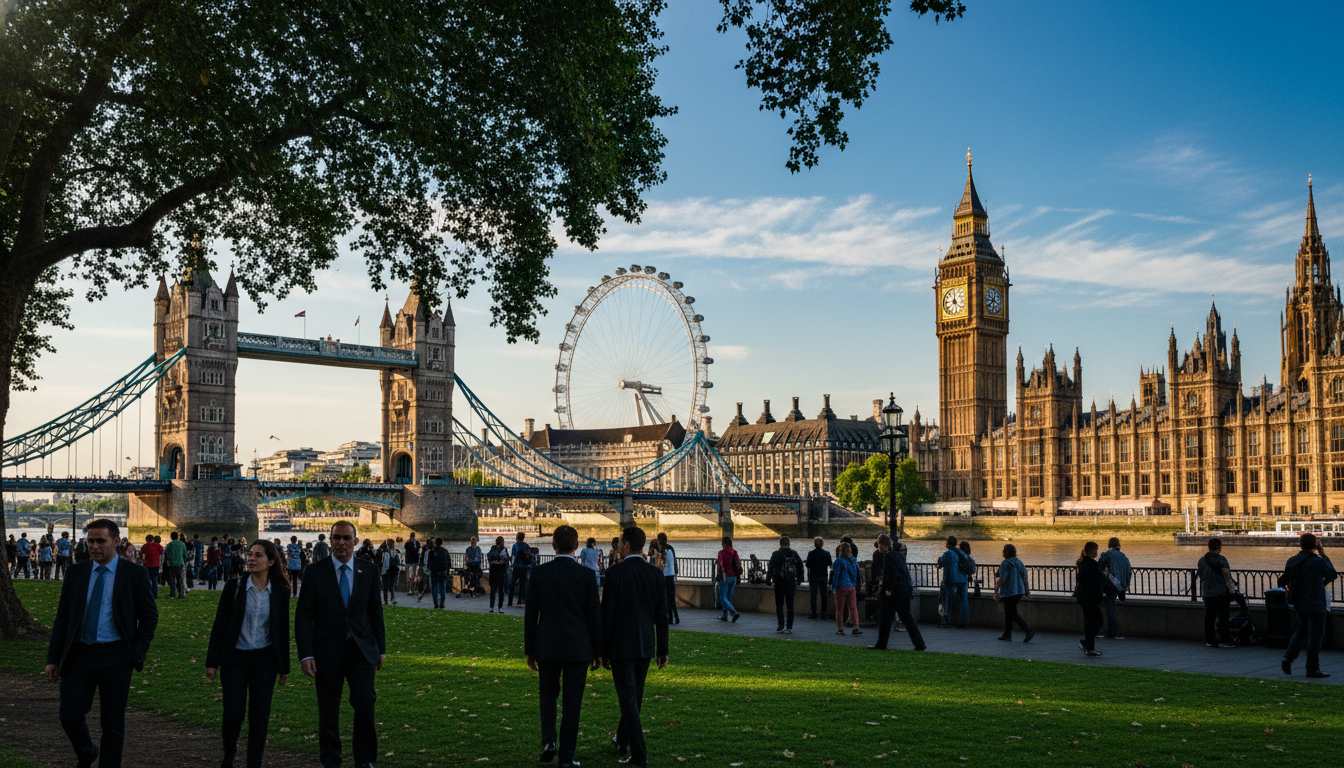
Major Attractions in London take you on a journey through 2,000 years of history in a single day. From ancient Roman times to modern marvels, the city offers an unmatched experience for every visitor.
Founded by the Romans in 43 AD as Londinium, London has grown into a top spot for history buffs. After the Romans left, the city’s role declined until Alfred the Great strengthened it. The Normans made it England’s capital, marking its global significance.
Today, London boasts a stunning array of palaces, museums, and iconic landmarks that share Britain’s story. You’ll see everything from ancient Roman ruins to medieval castles and grand churches. The city’s architecture shows the growth of cultures over centuries.
Whether you’re into royal homes or global museums, the major attractions in London have something for everyone. Top sites include Gothic Westminster Abbey and Art Deco buildings. This mix of old and new is truly unique.
London also offers a chance to dive into military history, art, and ancient civilizations. You’ll enjoy world-class visitor experiences that make history come alive.
Key Takeaways
- London was established by the Romans in 43 AD and evolved through Alfred the Great’s reign and the Norman conquest to become England’s capital
- The city features diverse heritage sites spanning 2,000 years, from Roman ruins to medieval castles and royal palaces
- Visitors can explore multiple historical periods in one destination, including ancient, medieval, and modern eras
- Architecture ranges from Gothic structures like Westminster Abbey to Art Deco buildings, reflecting centuries of development
- World-class museums house millions of artifacts from British history and global civilizations
- Royal residences, military sites, and cultural institutions offer immersive experiences for every type of history enthusiast
Iconic Landmarks and Monuments
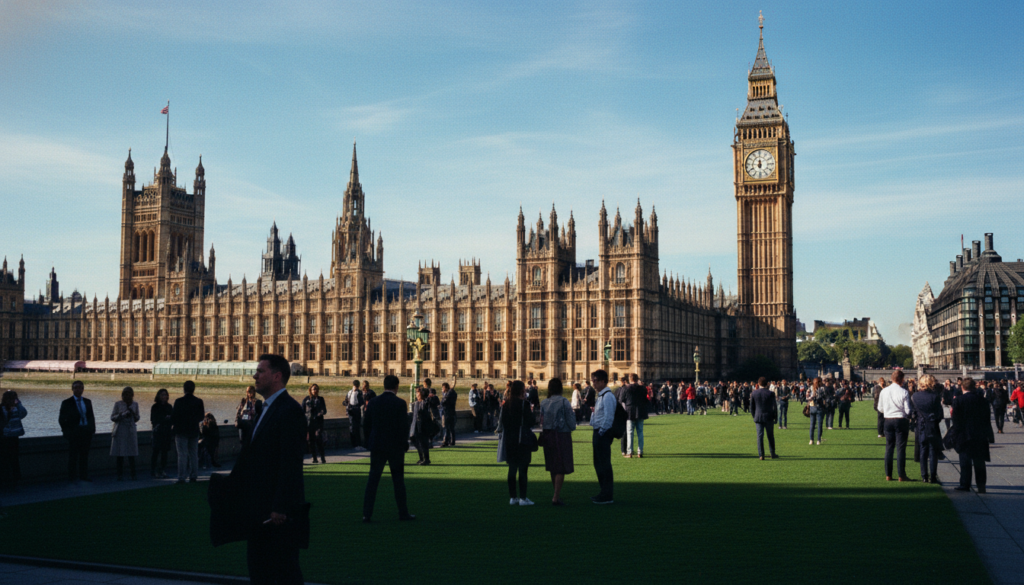
London’s landmarks show the city’s rich history and draw millions each year. These sites are symbols of British history, giving you unforgettable experiences. Each landmark tells a story of the people and events that shaped Britain.
These attractions are all over central London, making it easy to see several in one day. Their history and beauty make them must-see spots in London.
The Clock Tower and Westminster Palace
The Houses of Parliament, one of the major attractions in London, also known as the Palace of Westminster, is the UK’s parliament home. It was once a royal palace for over 500 years. King Henry VIII moved the royal family here in the 16th century.
The original palace burned down in 1834. The current Gothic Revival building was built by Sir Charles Barry and Augustus Pugin. It’s now a UNESCO World Heritage site.
The famous clock tower, home to Big Ben, is a key part of the complex. “Big Ben” is actually the Great Bell’s nickname, named after Sir Benjamin Hall. The clock tower was built from 1843 to 1859.
Parliament has met here for over a thousand years. Tours start in Westminster Hall, the oldest part of the palace. You can see the massive timber beams from 1393 and explore the chambers where laws are made.
Victorian Engineering on the Thames
Tower Bridge opened in 1894 by Prince of Wales, later King Edward VII. It was designed by Horace Jones and John Wolfe Barry. The bridge combines Victorian engineering with Gothic architecture.
The bridge’s twin towers and blue chains are famous worldwide. The bascule mechanism raises the roadway for tall ships to pass. It’s a sight to see if you visit at the right time.
The high-level walkways reopened in 1982. You can walk across glass panels 138 feet above the Thames. The exhibition shows the bridge’s engineering and the original steam engine rooms.
Modern Marvel on the South Bank
The London Eye, among the most popular major attractions in London, is Europe’s tallest observation wheel. It offers panoramic views of London. This landmark on the South Bank gives a unique view of the city.
Each rotation takes 30 minutes. You can see famous landmarks from your glass capsule. On clear days, you can see up to 25 miles in every direction.
The structure is 443 feet high with 32 capsules. Book tickets early, as it gets busy during peak seasons.
The Royal Residence
Buckingham Palace, one of London’s iconic major attractions, has been the monarch’s home for over 180 years. It was built for the Dukes of Buckingham in the 18th century. Queen Victoria made it the royal residence in 1837.
The palace is the home of King Charles III and Queen Camilla. It hosts state occasions like the Changing of the Guard and Royal Jubilee Celebrations.
You can visit the State Rooms in summer. These rooms show priceless artworks and furniture. The tour includes the Throne Room and the White Drawing Room.
The Changing of the Guard is a popular free attraction. Arrive early to get a good spot for the ceremony.
Nelson’s Memorial Square
Trafalgar Square is a vibrant public space with Nelson’s Column at its center. The column honors Admiral Lord Horatio Nelson, victor of the Battle of Trafalgar. It was built in the 19th century.
The column is 169 feet high, topped with a statue of Nelson. Four bronze lions guard the base, made from Royal Navy cannons. These lions are popular photo spots.
The square hosts events all year, from Christmas to cultural festivals. The National Gallery is nearby, making it a great place to see art and landmarks. The square’s fountains and steps are inviting, perfect for resting between visits.
Historic Palaces and Castles
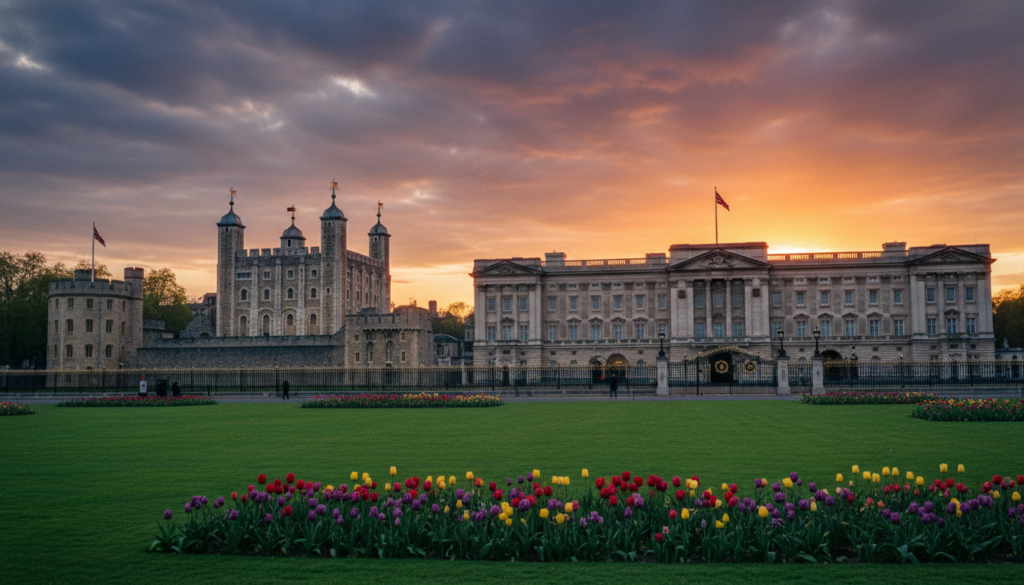
Exploring London’s royal palaces and castles takes you back nearly 1,000 years. These structures were the power centers for English monarchs. They saw dramatic events, lavish ceremonies, and shaped the nation’s destiny. Each palace has its own story of royal ambition, political intrigue, and architectural innovation.
These sites give a glimpse into the lives of kings, queens, and courtiers. You’ll see treasures, armor, and state rooms unchanged for centuries. They are working royal residences, showing Britain’s enduring monarchy.
The Tower of London: Fortress of History
The Tower of London is a world-famous fortress. Founded by William the Conqueror in 1066, it has played many roles. It was a royal residence, notorious prison, treasury, menagerie, and military armory.
The White Tower is the heart of this complex. It stands over 90 feet tall, built of Kentish ragstone. William the Conqueror built it as a symbol of Norman conquest and power.
Famous prisoners like Anne Boleyn and Sir Walter Raleigh were held here. You can see the cells where they awaited their fate.
The Yeoman Warders, or “Beefeaters,” have guarded the Tower. They give fascinating tours filled with stories of treachery, execution, and royal drama. Their colorful uniforms and knowledge bring history to life.
Don’t miss the Crown Jewels. This collection includes coronation regalia and crowns. The Royal Armouries collection shows medieval arms and armor.
“The Tower of London is not just a monument to the past; it is a living, breathing part of British heritage that continues to captivate millions of visitors each year.”
Early morning tours offer a quieter experience. You can explore before the crowds arrive.
Kensington Palace: Royal Residence Through the Ages
Kensington Palace started its royal journey in 1689. King William III and Queen Mary II bought it from the Earl of Nottingham. Architect Christopher Wren rebuilt and improved it for the monarchs.
Queen Anne, George I, and George II lived here. George I built new state rooms. Queen Caroline had beautiful gardens made on the grounds. The palace became a center of court life and power.
George III made Kensington Palace a secondary home. Today, you can visit the State Rooms and explore the King’s Gallery and Queen’s Apartments.
The palace gardens offer a peaceful escape. You’ll find manicured lawns, flower beds, and tree-lined paths. These have welcomed royalty for over three centuries.
Hampton Court Palace: Henry VIII’s Grand Estate
Hampton Court Palace is a stunning example of Tudor architecture. In 1514, Cardinal Wolsey leased it and rebuilt it grandly. His improvements made it rival royal residences.
Henry VIII took the palace after Wolsey’s fall. He renovated and extended it at a huge cost. This created the magnificent Tudor palace you see today.
The palace hosted Edward VI, Mary I, and Elizabeth I. Each monarch left their mark. You’ll see the famous maze, the Great Hall, and the Tudor kitchens.
The palace’s art collection includes works by famous masters. You can admire tapestries, paintings, and furnishings. The gardens feature geometric designs, fountains, and the Hampton Court maze.
Windsor Castle and Other Royal Treasures
Windsor Castle is the oldest and largest occupied castle in the world. It’s a weekend home of the royal family. You’ll see nearly 1,000 years of architectural evolution and royal history.
The castle’s State Apartments have some of the finest artworks in the Royal Collection. You can view paintings by Rembrandt, Rubens, and Canaletto. St George’s Chapel is the spiritual home of the Order of the Garter and the final resting place of many monarchs.
The Banqueting House in Whitehall is the only surviving building of the Palace of Whitehall. It was designed by Inigo Jones and has a magnificent ceiling painted by Peter Paul Rubens. The original Palace of Whitehall was acquired from Cardinal Wolsey by Henry VIII.
From 1654 to 1658, Oliver Cromwell made the Banqueting House his home. In 1698, a devastating fire burned the Palace of Whitehall to the ground. Christopher Wren converted the Banqueting House into a chapel, preserving it for future generations.
| Palace | Founded/Acquired | Notable Feature | Key Monarch |
|---|---|---|---|
| Tower of London | 1066 | Crown Jewels collection | William the Conqueror |
| Kensington Palace | 1689 | State Rooms and gardens | William III and Mary II |
| Hampton Court Palace | 1514 (by Wolsey) | Tudor maze and kitchens | Henry VIII |
| Windsor Castle | 11th century | St George’s Chapel | William the Conqueror |
These historic palaces and castles offer a unique journey through British royal history. Each shows different architectural styles and gives insight into monarchs’ lives and governance.
Plan your visits carefully, considering opening times and special events. Many palaces host ceremonies, concerts, and exhibitions. You can buy combination tickets for better value.
Major Attractions in London: World-Famous Museums
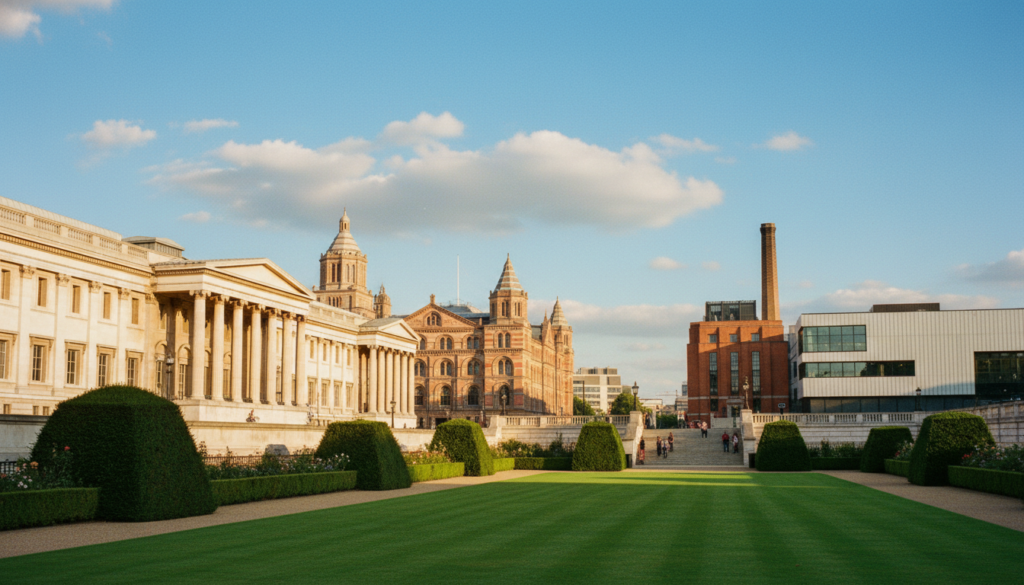
London’s museums are home to some of the world’s most amazing collections. They show us art, science, and history. You can see treasures from all over the world for free.
These museums are among the biggest attractions in London. Millions visit each year to see things they can’t find anywhere else.
A Treasure House of Human History
The British Museum is a top place for learning about human history and culture. It was started in 1753 and now has over 8 million objects from all over the world.
Three famous items draw visitors from everywhere. The Rosetta Stone helped us understand ancient Egyptian writing. The Assyrian lion statues show the power of ancient Mesopotamia. The bust of Nefertiti shows the beauty of Egypt’s royal court.
The museum has many other amazing things. You can see Babylonian stonework, Samurai armor, and Roman pottery. There’s always something new to discover.
To get the most out of your visit, try these:
- Free audio guides for more info on exhibits
- Three-hour tours to see the best treasures
- Guided tours for deeper insights
- Special tours for kids aged 3-13
- Family tours to keep everyone interested
Exploring the Wonders of Nature
The Natural History Museum takes you on a journey through the natural world. The grand main hall welcomes you with amazing displays of Earth’s diversity.
The museum’s dinosaur skeletons are a big hit. You can see creatures from millions of years ago. The blue whale model shows the size of the ocean’s biggest animals. Specimen collections cover geology, mineralogy, zoology, and botany.
Interactive exhibits make science fun for all ages. You can learn about evolution, earthquakes, and ecosystems. It’s a hands-on way to understand complex topics.
Design and Decorative Arts Excellence
The Victoria and Albert Museum focuses on design and decorative arts from around the world. It has over 3,000 years of human creativity. It’s one of the biggest museums for applied arts.
You’ll see Ancient Chinese ceramics and Indian sculptures. There are also medieval and renaissance masterpieces. These show European art during great cultural times.
The museum’s collections include:
- Fashion and textiles from different times
- Furniture and woodwork showing design changes
- Metalwork and jewelry highlighting craftsmanship
- Photography and graphic arts in visual communication
- Sculpture and architectural elements from famous buildings
The museum shows how beauty and function come together. It helps you see how design shapes our lives and reflects culture.
Scientific Innovation on Display
The Science Museum brings technology and science to life. Unlike other museums, you can experiment and learn by doing. It’s a place where curiosity meets innovation.
Exhibitions show groundbreaking discoveries and inventions. You can see how transportation, communication, medicine, and computing have changed. The museum makes science easy to understand and shows how innovation has changed our lives.
Conflicts and Their Impact
The Imperial War Museum looks at worldwide conflicts, focusing on the First and Second World Wars. It goes beyond military items to show the human side of war. It explores social, political, and cultural impacts.
Exhibitions cover many aspects of conflict. You can see military strategies, technology, and the Holocaust’s tragedy. There’s also information on women’s roles in war, artwork from conflicts, and the political reasons for war. The museum presents these topics thoughtfully, encouraging reflection on war’s effects.
The Imperial War Museum is child-friendly. It has special exhibits like WWI trenches for kids. These displays make history real and memorable without being too scary for young minds.
| Museum | Primary Focus | Notable Collection Highlights | Best For |
|---|---|---|---|
| British Museum | Human history and culture | Rosetta Stone, Egyptian mummies, Greek sculptures | History enthusiasts and world culture explorers |
| Natural History Museum | Natural sciences and specimens | Dinosaur skeletons, blue whale, mineral collections | Families and nature lovers |
| Victoria and Albert Museum | Design and decorative arts | Fashion, furniture, ceramics, textiles | Art and design aficionados |
| Science Museum | Scientific and technological innovation | Interactive exhibits, computing history, transportation | Technology enthusiasts and curious minds |
| Imperial War Museum | Military conflicts and their impacts | WWI and WWII exhibits, Holocaust memorial, wartime art | History students and those interested in military history |
Each of these museums offers unique views and collections. They help us understand human achievements, natural wonders, and history. With free general admission, you can explore these treasures without spending a lot. London’s museums are open to everyone, no matter their budget.
London’s Major Attractions: Celebrated Art Galleries
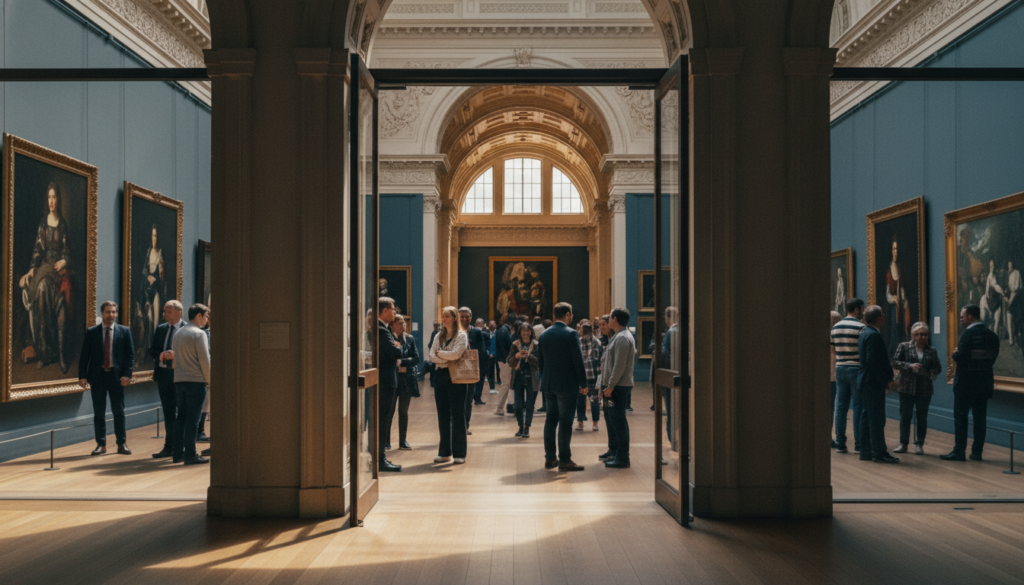
London is home to four famous art galleries. They have millions of artworks that show the best of human creativity. You can see these masterpieces for free.
These galleries are in central London. You can visit them all in one day. Plan your route to make the most of your time.
A Treasure Trove in Trafalgar Square
The National Gallery is one of the world’s top art museums. It has over 2,300 paintings from the 13th century to 1900. You’ll see works by Leonardo da Vinci, Vincent van Gogh, and Rembrandt.
The building itself is worth seeing. It has a neoclassical facade and a modern addition. You can see the collection for free, but some special shows need tickets.
Must-see artworks include:
- Van Gogh’s “Sunflowers” – a famous painting
- Leonardo da Vinci’s “The Virgin of the Rocks” – a Renaissance masterpiece
- Turner’s “The Fighting Temeraire” – Britain’s favorite painting
- Caravaggio’s “Supper at Emmaus” – known for dramatic light and shadow
- Botticelli’s “Venus and Mars” – a beauty of the Italian Renaissance
You can get free audio guides for expert commentary. The gallery offers daily talks and tours. Visit on weekday mornings for a quieter experience.
Contemporary Art in an Industrial Cathedral
Tate Modern is in a former power station. It opened in 2000 and shows modern and contemporary art. You’ll see works by Picasso, Warhol, and Rothko.
The Turbine Hall has big installations. You can go to the 10th floor for a view of London. It’s worth it for the view of St. Paul’s Cathedral.
The collection is organized differently:
- Materials and Objects – how artists use materials
- Performer and Participant – art that involves the audience
- Media Networks – technology’s impact on art
- In the Studio – creative processes
The gallery is open late on Fridays and Saturdays. You can take a boat to Tate Britain. Download the Tate app for more information.
The Home of British Artistic Heritage
Tate Britain shows British art from 1500 to today. It has a huge collection of J.M.W. Turner’s works. You’ll also see Pre-Raphaelite paintings and modern British art.
The building is elegant and overlooks the Thames. You can see how British art has changed. Every major British artist is represented.
Highlights include:
- The Turner Collection – over 300 oils and 30,000 sketches by Britain’s greatest landscape painter
- John Everett Millais’ “Ophelia” – a famous Pre-Raphaelite work
- Francis Bacon’s striking triptychs – powerful examples of 20th-century expressionism
- Henry Moore sculptures – defining works of British modernism
Free guided tours run daily. The gallery hosts the Turner Prize exhibition each autumn. It’s quieter than other museums, perfect for viewing.
Faces That Shaped History
The National Portrait Gallery shows British history through portraits. You’ll see portraits of monarchs, scientists, and cultural icons. The collection has over 215,000 artworks.
The gallery is organized by time, not style. You start with Tudor portraits and go down through the centuries. This way, you see British history through portraits.
Notable portraits include:
| Historical Figure | Artist | Significance | Period |
|---|---|---|---|
| King Henry VIII | Hans Holbein | Iconic image of Tudor power | 16th Century |
| William Shakespeare | Chandos Portrait | Only authenticated lifetime image | 17th Century |
| The Brontë Sisters | Branwell Brontë | Rare portrait by their brother | 19th Century |
| Queen Elizabeth II | Cecil Beaton | Defining coronation portrait | 20th Century |
You can see temporary exhibitions and commissioned works. The gallery offers audio guides. It’s close to Trafalgar Square, near the National Gallery.
These galleries offer a unique journey through art. You’ll appreciate human creativity and see important artworks. Plan to spend at least half a day at each gallery.
Historic Churches and Cathedrals
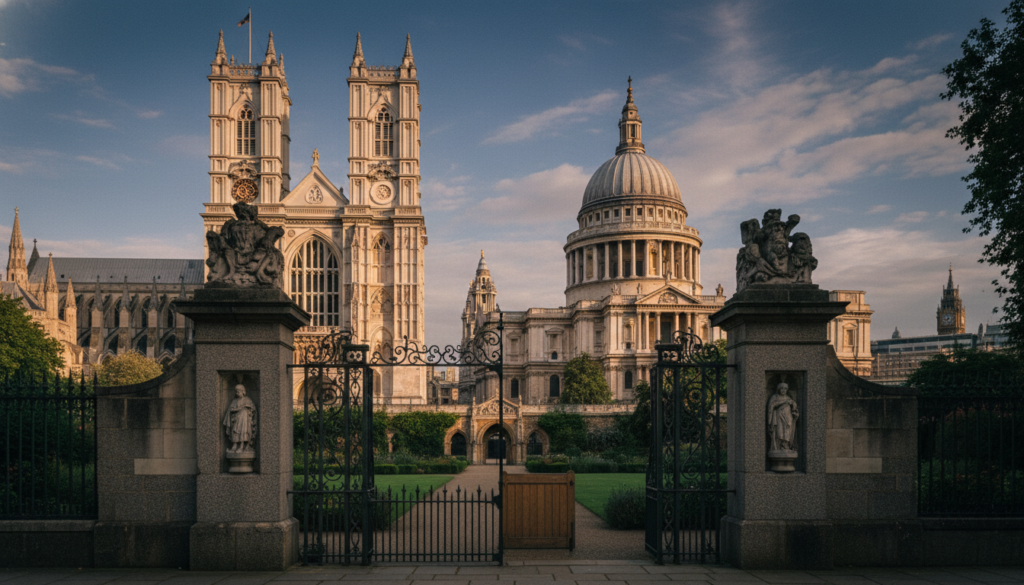
London’s historic churches and cathedrals are architectural wonders. They’ve seen coronations, royal weddings, and state funerals. Each building tells a story of faith and national heritage.
Visiting these landmarks is like stepping into a living museum. Here, architecture, art, and history come together in stunning ways.
The Coronation Church of British Monarchs
Westminster Abbey is a medieval marvel, the coronation church for British monarchs. It was built in the eleventh century for St Peter. For nearly a thousand years, it’s been the spiritual heart of the British monarchy.
The Coronation Chair is a treasured artifact. King Edward I had it made in 1300-1301 for the Stone of Scone. Today, you can see this historic throne.
Poets’ Corner is famous for its non-royal figures. It’s the final resting place for many cultural icons. The Henry VII Lady Chapel has fan-vaulted ceilings that showcase Gothic architecture.
Tours are highly recommended to fully appreciate the abbey. They provide context to the abbey’s history and architecture.
- View the Coronation Chair and Stone of Scone
- Explore Poets’ Corner memorials and tombs
- Admire the Henry VII Lady Chapel’s vaulted ceiling
- Learn about royal weddings and coronations
- Discover burial sites of kings and queens
Christopher Wren’s Architectural Masterpiece
St Paul’s Cathedral stands tall on Ludgate Hill. It’s the second-largest church in England. Sir Christopher Wren designed it, taking over 35 years to complete.
The cathedral’s dome symbolizes London’s resilience. Wren redesigned it twice before officials accepted the final version. The dome was finished in 1710, with the cathedral taking another 16 years to complete.
St. Paul’s Cathedral serves as a parish church and Anglican cathedral. It’s also the ceremonial site for the Archbishop of Canterbury during national events.
Visiting the Golden Gallery at the dome’s top is a challenge. But the views of the city are worth it. The Whispering Gallery’s acoustics are unique, allowing whispers to travel across the dome.
The crypt houses tombs of national heroes like Admiral Nelson and the Duke of Wellington. Exploring London’s attractions includes St Paul’s spiritual and historical significance.
- Climb to the Golden Gallery for city views
- Experience the Whispering Gallery’s acoustics
- Visit the crypt and memorial chapels
- Attend evensong services for choral music
- Explore the cathedral’s art collections
London’s Oldest Gothic Church Building
Southwark Cathedral is London’s oldest Gothic church. It dates back to medieval times. Unlike royal churches, it offers a glimpse into London’s religious heritage.
The cathedral has beautiful stained glass and stonework. Its riverside location makes it close to Borough Market and other attractions. It’s a must-see in the area.
Southwark Cathedral is quieter than Westminster Abbey. You can explore at your own pace. It hosts concerts and community events, keeping its role as a place of worship.
The Knights Templar’s Round Church
Temple Church is a unique and historically significant site. The Knights Templar built it in the 12th century. Its circular nave is unlike any other church.
The Temple complex includes medieval buildings in the City of London. Lawyers and barristers now work here, but the church remains a place of worship. It’s a fascinating contrast of old and new London.
The church is famous from popular culture, but its historical importance is vast. Medieval knights’ effigies lie on the floor. They honor the Templar knights who once worshipped here.
Visiting hours are limited due to its private location. Check before planning your visit. When open, Temple Church offers a unique look into medieval military orders and architecture.
| Cathedral | Construction Period | Architectural Style | Key Feature |
|---|---|---|---|
| Westminster Abbey | 11th century (1066) | Gothic | Coronation Chair and Poets’ Corner |
| St Paul’s Cathedral | 1675-1710 | Baroque | Iconic dome with viewing galleries |
| Southwark Cathedral | Medieval (12th-13th century) | Gothic | Oldest Gothic church in London |
| Temple Church | 12th century (1160s-1185) | Romanesque/Gothic | Round nave modeled on Jerusalem church |
Royal Parks and Gardens
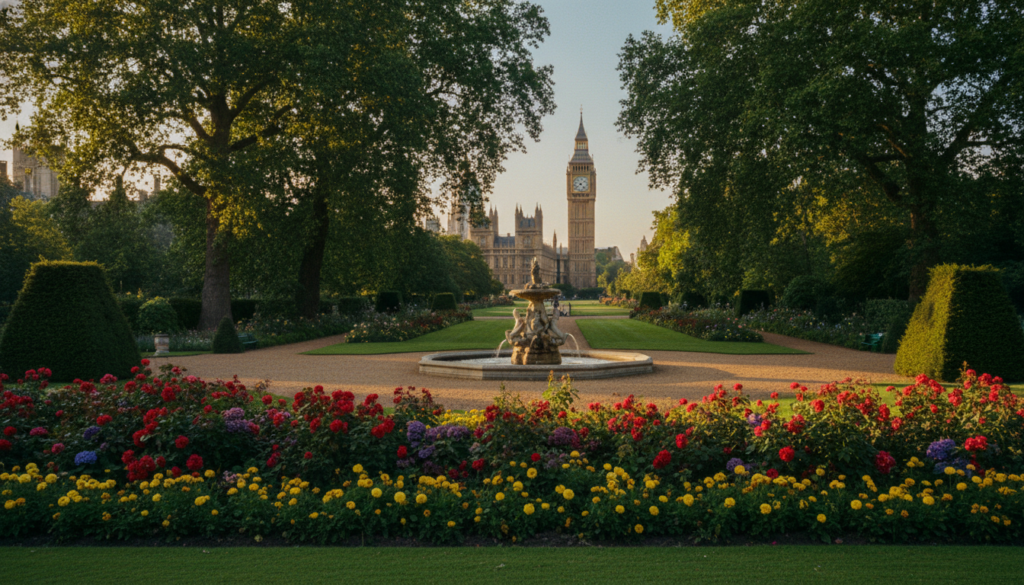
London’s royal parks and gardens are peaceful green spaces. They let you escape the city’s hustle and discover royal heritage. These areas have been recreational havens for Londoners for centuries.
Each park has its own unique character. You can find everything from formal gardens to wild meadows. This offers diverse experiences during your visit.
The royal parks and gardens cover thousands of acres in central London. They show the crown’s long relationship with nature and public welfare. They are near major attractions, making them perfect for resting between sightseeing.
One of London’s Largest Green Spaces
Hyde Park is a huge 350 acres in the heart of London. It was a royal hunting ground by Henry VIII in 1536. It became a public space in the early 17th century.
The Serpentine lake is the park’s centerpiece. You can rent boats here during warmer months. The lake divides Hyde Park from Kensington Gardens and offers swimming, boating, and relaxation.
Speaker’s Corner has been at the park’s northeast edge for over a century. It’s where anyone can speak freely on any topic. Every Sunday, you can see passionate debates and diverse perspectives.
The Diana Princess of Wales Memorial Fountain is a peaceful spot in Hyde Park. It reflects Diana’s life with a circular stream. You can walk barefoot through the shallow water or sit on the stone to enjoy this tribute.
Nash’s Masterpiece of Landscape Design
Regent’s Park was designed by architect John Nash in the 1810s. It covers 395 acres and combines formal gardens, walkways, and meadows. Nash created elegant terraces and sight lines for the Prince Regent.
Queen Mary’s Gardens is the park’s highlight, with over 12,000 roses. The roses bloom from late spring to early autumn, filling the air with fragrance. You can see vibrant colors, pergolas, and benches for relaxation.
The boating lake at Regent’s Park offers fun from April to October. You can rent boats to explore the water’s three islands. The lake’s shape and wooded banks offer beautiful views.
London Zoo is at the park’s northern edge, having been there for 1847. This makes Regent’s Park unique. You can visit the park and zoo together, enjoying both nature and exotic animals.
A UNESCO World Heritage Botanical Wonder
Kew Gardens is a UNESCO World Heritage Site. It spans 300 acres along the Thames. It has the world’s largest and most diverse plant collections.
The Victorian glasshouses are iconic at Kew. The Palm House, built in 1848, creates a tropical environment. The Temperate House, recently restored, is the largest surviving Victorian glasshouse in the world.
A treetop walkway takes you 59 feet above the ground. It offers views of the garden canopy. This walkway shows ecosystem layers often hidden from ground-level observers.
Kew Palace is the oldest surviving structure in the gardens. Built around 1631, it features distinctive decorative brickwork and gables. The palace opened to the public in 1898, allowing you to explore rooms where King George III and his family lived.
London’s Most Historic Royal Park
St James’s Park is London’s oldest royal park, dating to the 1530s. It covers 57 acres in Westminster’s heart. It’s a green corridor between Buckingham Palace and Whitehall, making it perfect for visiting nearby historic sites.
The park’s lake is home to a colony of pelicans. This tradition started in 1664 when the Russian Ambassador gifted the birds to King Charles II. You can watch the pelicans during their daily feeding at 2:30 PM.
Stunning views of Buckingham Palace emerge from the Blue Bridge crossing the lake. This spot offers picture-perfect perspectives of the palace. Early morning visits are best for beautiful light and fewer crowds.
The park’s landscaping reflects the English pastoral style. It has rolling lawns and mature trees, creating a countryside atmosphere. Flower beds bloom throughout the year. You’ll find great picnic spots with views of historic buildings.
| Park Name | Size | Key Features | Unique Attraction | Best For |
|---|---|---|---|---|
| Hyde Park | 350 acres | Serpentine lake, Speaker’s Corner, Diana Memorial Fountain | Free speech demonstrations at Speaker’s Corner | Boating, swimming, public discourse |
| Regent’s Park | 395 acres | Queen Mary’s Gardens, boating lake, formal terraces | 12,000 roses in Queen Mary’s Gardens | Rose enthusiasts, family activities |
| Kew Gardens | 300 acres | Victorian glasshouses, treetop walkway, Kew Palace | UNESCO World Heritage Site status | Botanical study, photography, history |
| St James’s Park | 57 acres | Pelican colony, palace views, central location | Oldest royal park in London | Palace photography, pelican watching |
These royal parks and gardens are vital in London’s urban fabric. They offer ecological benefits, recreational activities, and connections to royal history. Whether you seek peace, family fun, or a break from museums, these spaces offer memorable experiences all year.
Popular Markets and Shopping Areas
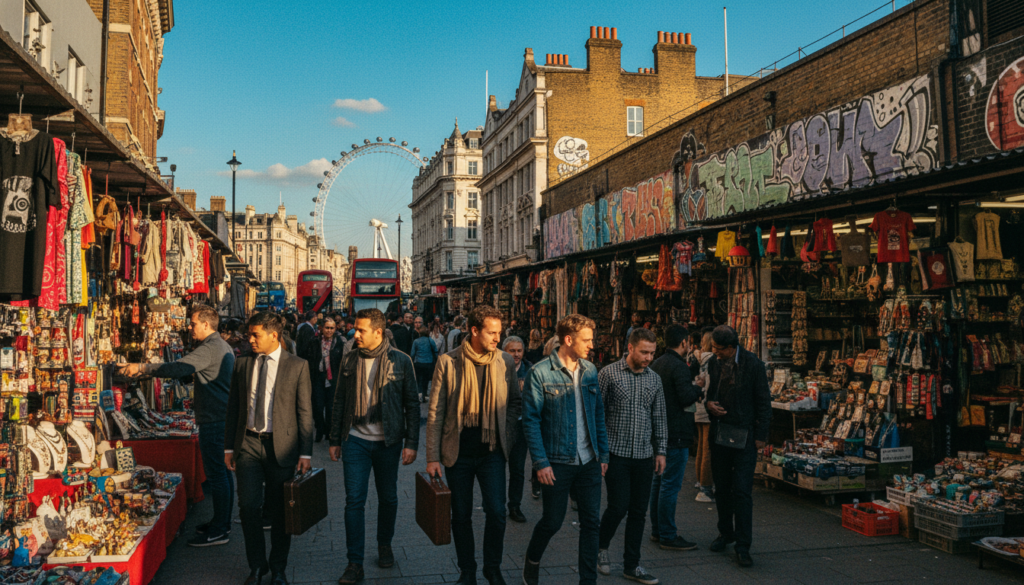
London’s popular markets and shopping areas offer unique experiences for all. You can find everything from antique treasures to artisan foods. These markets give you a real taste of local life, with authentic encounters with the city’s diverse communities.
Each market has its own special character and items. You’ll find rare collectibles, handcrafted jewelry, and organic produce. These places are must-visit spots in London, filled with energy and authenticity.
A Feast for Your Senses at the Historic Food Hall
Borough Market is one of London’s oldest and most loved food spots. It’s been trading for over 1,000 years. Located near London Bridge, it showcases the best of British and international foods.
With over 100 stalls, you’ll find artisan cheeses, fresh breads, organic meats, and specialty ingredients. The market is busiest on Thursday to Saturday. Arrive early to beat the crowds and get the best picks.
Many vendors offer tastings, so you can try before you buy. Nearby, you can visit Southwark Cathedral and the Golden Hinde replica ship. It’s a great way to see history and enjoy food.
Alternative Culture and Creative Energy
Camden Market in North London is known for its bohemian vibe. It’s a mix of markets, including Camden Lock and Stables Market. Here, you’ll find alternative fashion, vintage clothes, and handmade crafts.
The market is open every day, but weekends are the busiest. You can try foods from around the world and enjoy live music. It’s perfect for those looking for unique style and artistic expression.
Exploring Camden takes time. There are maze-like passages and hidden courtyards. Regent’s Canal offers scenic walks and cafes for a break.
Theatrical Charm and Street Entertainment
Covent Garden used to be a fruit and vegetable market but now it’s a top shopping and entertainment spot. The historic building houses boutique shops and craft stalls. The Apple Market is famous for antiques on Mondays and handmade items the rest of the week. Street performers add to the festive atmosphere in the piazza.
The area is open every day, with shops having different hours. Surrounding streets have luxury brands and independent shops. The Royal Opera House is nearby, with backstage tours available.
Covent Garden has great places to eat, from casual spots to fine restaurants. The covered market areas are perfect for shopping, rain or shine.
Antique Treasures in Colorful Notting Hill
Portobello Road Market is a two-mile stretch in West London’s Notting Hill. On Saturdays, it becomes the world’s largest antiques market. Early birds get the best deals, so arrive before 9 AM.
There are different sections for various items throughout the week. The south has antiques, the middle has fresh produce, and the north has vintage fashion. It’s a treasure trove for bargain hunters.
The colorful houses along the street are perfect for photos. Nearby, you can visit the Museum of Brands and the Electric Cinema. Don’t miss the side streets with independent shops and cafes.
Leadenhall Market in the City of London is also worth a visit. It’s over 700 years old and has stunning Victorian architecture. It’s famous for being the filming location of Diagon Alley in Harry Potter, adding magic to its charm.
| Market | Best Day to Visit | Primary Specialties | Nearest Tube Station |
|---|---|---|---|
| Borough Market | Thursday-Saturday | Artisan foods, fresh produce, international cuisine | London Bridge |
| Camden Market | Saturday-Sunday | Alternative fashion, vintage clothing, crafts | Camden Town |
| Covent Garden | Daily | Boutique shopping, antiques, street entertainment | Covent Garden |
| Portobello Road | Saturday | Antiques, vintage items, collectibles | Notting Hill Gate |
When visiting London’s markets, bring cash for small vendors. Wear comfy shoes for lots of walking. The best moments often come from unexpected discoveries.
Theatre and Entertainment Venues
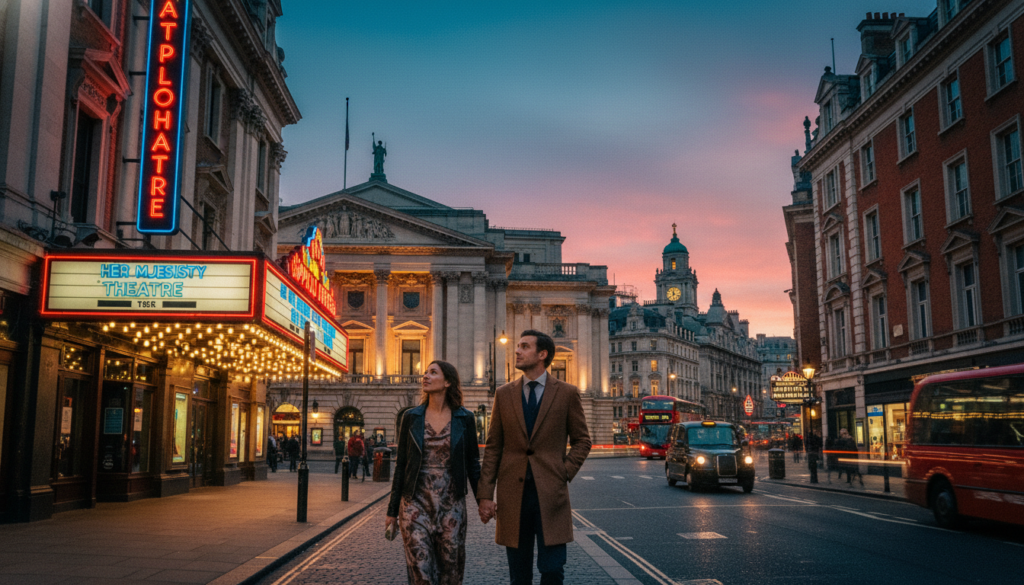
London’s theatre and entertainment venues offer top-notch shows every night. You’ll see a mix of old and new, from classic plays to modern musicals. The city’s entertainment scene has something for everyone.
London is known worldwide for its entertainment. You can see international talent and local shows. The variety of venues means you’ll find something you like, from small theaters to big concert halls.
West End Theatre District
The West End is London’s Broadway, with over 40 theaters. You’ll find shows from classics to new hits. The theaters have been entertaining for over a century.
See legendary shows like The Phantom of the Opera and Les Misérables. The theaters’ Victorian and Edwardian designs add to the magic. You can easily explore the area’s theaters.
Booking tickets for popular shows can be tricky. Buy from box offices, official websites, or authorized agents. The TKTS booth in Leicester Square offers last-minute deals.
Here are tips for a great West End experience:
- Book popular shows weeks in advance for the best seats
- Matinee shows on Wednesdays and Saturdays are cheaper
- Standing room and day seats are budget-friendly
- Check official websites for special deals
- Arrive early to collect tickets and find your seats
Shakespeare’s Globe
Shakespeare’s Globe takes you back to Elizabethan England. It’s a faithful recreation of the original playhouse. The theater stands as a monument to Shakespeare.
Watch performances like audiences did 400 years ago. The open-air design means performances are under natural light. The season runs from April to October.
Guided tours reveal the secrets of Shakespearean theater. You’ll learn about the original Globe and its reconstruction. The on-site exhibition explores Elizabethan theater through interactive displays.
Royal Albert Hall
The Royal Albert Hall is one of London’s most famous venues. It hosts over 390 events a year. The venue’s acoustics and 5,272-seat capacity create an intimate atmosphere.
Experience the BBC Proms, a summer festival of classical music. The Proms offer affordable standing tickets. The Last Night celebration is a beloved tradition.
The hall’s programming includes film screenings and graduation ceremonies. Take daytime tours to explore its history and architecture. The tours reveal stories about legendary artists.
Southbank Centre
The Southbank Centre is Europe’s largest arts complex. It includes the Royal Festival Hall and more. You’ll find over 5,000 events a year across various arts.
The centre offers a diverse program for all tastes. You’ll see classical music, jazz, and more. The literature program features author readings and discussions.
The complex has outdoor spaces for walks and performances. Enjoy riverside strolls and weekend markets. The atmosphere encourages exploration and discovery.
| Venue | Primary Programming | Capacity | Special Features |
|---|---|---|---|
| West End Theatres | Musicals, plays, comedies | 500-2,300 seats | 40+ venues, historic architecture, TKTS discounts |
| Shakespeare’s Globe | Shakespeare and Elizabethan drama | 1,400 (857 seated, 700 standing) | Open-air performances, authentic reconstruction, educational tours |
| Royal Albert Hall | Classical music, concerts, ceremonial events | 5,272 seats | BBC Proms, iconic architecture, diverse programming |
| Southbank Centre | Music, dance, literature, visual arts | 2,700 (Royal Festival Hall) | Multiple venues, free outdoor events, riverside location |
London’s entertainment venues include historic spots like the Banqueting House. Kenwood House hosts summer concerts in its gardens. These venues make your visit unforgettable, filled with cultural experiences.
Family-Friendly Visitor Attractions
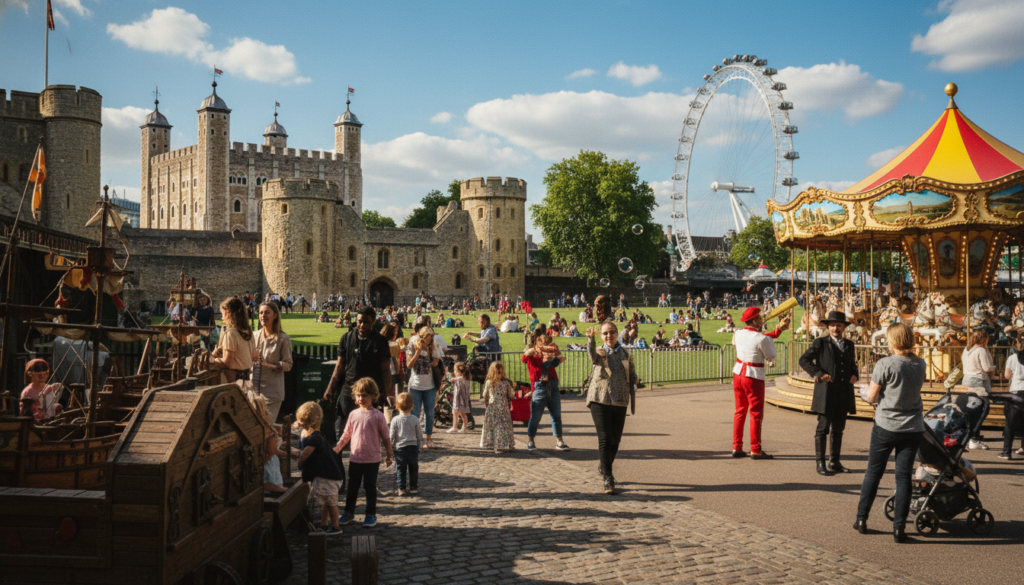
London’s family attractions offer fun and learning. They mix wildlife, movies, and more for a great time. Kids and adults leave with memories and stories to share.
London has attractions for all interests. Parents love places that teach and entertain. Kids enjoy hands-on fun that lets them explore and discover.
Exploring the World’s Oldest Scientific Zoo
London Zoo opened in 1828 in Regent’s Park. It’s one of the oldest zoos. Families see over 750 species, from lions to gorillas.
Interactive exhibits make London Zoo great for kids. They can watch animal feeding and learn about conservation. The reptile house is a hit with its snakes and crocodiles.
“Zoo Nights” events are special. They let families see animals at night. It’s a unique experience that makes London Zoo stand out.
Underwater Adventures on the South Bank
The SEA LIFE London Aquarium is huge. It’s on the South Bank and has ocean tunnels. Families feel like they’re underwater without getting wet.
Hands-on learning is key at SEA LIFE London Aquarium. Kids can touch starfish and crabs. It’s a hands-on way to learn about marine life.
The aquarium teaches about ocean threats. It shows how to protect marine habitats. Kids learn through fun, interactive displays.
Celebrity Encounters in Wax
Madame Tussauds mixes museum and fun. Families meet wax figures of celebrities and more. It’s a place where learning meets fun.
Madame Tussauds has areas for all ages. Kids love the Marvel Super Heroes section. Star Wars fans get to explore a galaxy far, far away.
This attraction encourages creativity. Unlike museums, visitors can touch and interact with displays. Families make fun, personalized memories.
Magic Behind the Movies
The Warner Bros Studio Tour is a must for Harry Potter fans. It’s outside London. Families see real sets from the movies.
Costumes and props show the magic of movies. Kids learn about filmmaking. It’s fun for both fans and casual viewers.
Visitors can taste Butterbeer and see how special effects work. Interactive demonstrations show how movies are made.
Advance booking is key for the Warner Bros Studio Tour. It’s very popular. Families should book weeks in advance, even for summer.
Additional Family Entertainment Options
The London Dungeon is a mix of history and horror. It’s for older kids and teens. It’s educational but can be scary for younger kids.
Many museums offer great experiences for families. The British Museum has tours for kids. The Natural History Museum has dinosaur skeletons that fascinate kids.
The Imperial War Museum has WWI trench reconstructions. HMS Belfast lets families explore a WWII ship. These experiences make learning fun and interactive.
| Attraction | Recommended Age | Time Needed | Booking Advice |
|---|---|---|---|
| London Zoo | All ages | 3-4 hours | Book online for discounts |
| SEA LIFE London Aquarium | All ages | 2-3 hours | Advance tickets recommended |
| Madame Tussauds | 5+ years | 2-3 hours | Skip-the-line tickets essential |
| Warner Bros Studio Tour | 6+ years | 3-5 hours | Book weeks in advance |
| London Dungeon | 12+ years | 1-2 hours | Online booking for best prices |
Booking tickets online in advance is smart. It saves time and money. Many attractions offer combo tickets for more value.
Visit when doors open for smaller crowds. Weekdays are quieter than weekends. This works best for families with flexible plans.
London’s attractions make learning fun. Each place offers education and entertainment. Parents and kids enjoy these experiences together.
Tips for Exploring Visitor Attractions in London
Planning ahead makes your London trip smoother and more fun. Book tickets online early for places like the Churchill War Rooms and Tower of London. This way, you avoid long lines and get the time you want.
Choosing the right time can make your visit better. Go to the Tower of London early to beat the crowds. Visit museums on weekdays for a quieter experience. Save outdoor spots for sunny days.
Enjoy top culture without spending a lot. The British Museum and Natural History Museum are free. But, you might need to pay for special exhibits.
Guided tours add depth to complex sites. Tours at Westminster Abbey show you more than you’d see alone. Context Travel offers unique views of London’s history. The Churchill War Rooms has daily tours of its main areas.
Use an Oyster card or contactless payment for easy travel. Wear comfy shoes for walking around London. These tips help you make the most of your London visit.
FAQ
Do I need to book tickets in advance for London’s historical attractions?
Yes, booking tickets online in advance is recommended for many popular attractions. Sites like the Tower of London and Warner Bros Studio Tour require timed entries. This ensures entry and often offers discounts and skips long queues.
Many museums, including the British Museum and National Gallery, offer free admission to their permanent collections. You don’t need to book in advance for these. But, special exhibitions may require tickets.
Which London museums offer free admission?
Many world-class museums in London offer free entry to their permanent collections. These include the British Museum, Natural History Museum, and National Gallery. You can explore these without paying.
Special temporary exhibitions at these museums usually require paid tickets. So, check before you go.
What is the best time to visit the Tower of London to avoid crowds?
Visit the Tower of London early in the morning to avoid crowds. Book an early morning tour to see the Crown Jewels with minimal wait. Weekday mornings are less crowded than weekends.
Arriving at 9:00 AM gives you a peaceful experience. The off-season months (November to March) also have fewer tourists.
Can you visit inside Buckingham Palace?
Yes, you can visit the State Rooms at Buckingham Palace during summer months. The palace opens to visitors when the Royal Family is not in residence. You can see treasures and explore the gardens.
Tickets must be booked in advance as availability is limited. The Changing of the Guard ceremony is free to watch outside the palace.
What does the name Big Ben actually refer to?
Big Ben refers to the Great Bell in the clock tower, not the tower itself. The tower was renamed the Elizabeth Tower in 2012. The Great Bell weighs over 13 tons and has been ringing out across Westminster for over a century.
The clock tower is part of the Houses of Parliament complex. You can book tours to explore Westminster Hall and witness the heart of British democracy.
How long should I plan to spend at the British Museum?
Plan to spend at least 3-4 hours at the British Museum. It houses over 8 million objects. You can see major highlights like the Rosetta Stone and ancient Assyrian lion statues.
The museum offers suggested three-hour itineraries. You can also book an expert-led tour for a deeper experience. Free audio guides are available to help you navigate.
Is Westminster Abbey the same as Westminster Cathedral?
No, Westminster Abbey and Westminster Cathedral are two different buildings. Westminster Abbey is an Anglican church with origins dating back to the 11th century. It has been the coronation church for British monarchs.
Westminster Cathedral is the Roman Catholic cathedral, built in the 19th century. It is located about half a mile southwest of the Abbey. Most tourists prioritize Westminster Abbey due to its central role in British history.
Can you walk across the glass floor at Tower Bridge?
Yes, you can walk across the high-level glass floor walkways at Tower Bridge. This experience is part of the Tower Bridge Exhibition. You can also explore the Victorian engine rooms and enjoy panoramic views of London.
The bridge opened in 1894 and remains one of London’s most photographed landmarks. Access to the exhibition requires a ticket, which should be booked in advance during peak tourist seasons.
What are the Churchill War Rooms?
The Churchill War Rooms are a preserved underground complex from World War II. It served as Winston Churchill’s secret headquarters. Today, it offers a glimpse into Britain’s wartime leadership.
The site includes the Cabinet War Rooms, the Transatlantic Telephone Room, the Broadcasting Studio, and Churchill’s living quarters. Due to its underground location, timed entry tickets should be booked in advance.
Which royal palace has the famous hedge maze?
Hampton Court Palace is home to London’s famous hedge maze. The maze was planted in the 1690s for William III. It features half a mile of paths lined with hornbeam and yew hedges.
Hampton Court offers extensive attractions, including the Great Hall and the Tudor Kitchens. It is located in Richmond upon Thames and is easily accessible from central London.
Are guided tours worth it at Westminster Abbey?
Yes, guided tours are highly recommended at Westminster Abbey. The sheer volume of history and architecture can be overwhelming without expert interpretation. A knowledgeable guide can help you understand the significance of features like the Coronation Chair and Poets’ Corner.
Audio guides are included with admission, but live guided tours offer the opportunity to ask questions and receive insights tailored to your interests. Without guidance, many visitors find themselves wandering aimlessly through this architectural masterpiece.
What is the difference between Tate Modern and Tate Britain?
Tate Modern and Tate Britain are two separate museums with distinct focuses. Tate Modern is Britain’s national museum of modern and contemporary art. It features works from 1900 to the present day.
Tate Britain houses the world’s largest collection of British art from 1500 to the present day. It includes works by J.M.W. Turner and the Pre-Raphaelite masterpieces. Both museums offer free admission to permanent collections.
When is the best time to see the Changing of the Guard at Buckingham Palace?
The Changing of the Guard ceremony at Buckingham Palace typically takes place at 11:00 AM. It lasts approximately 45 minutes. The ceremony occurs on Mondays, Wednesdays, Fridays, and Sundays throughout most of the year.
Arrive at least 45 minutes before the ceremony begins for the best viewing position. The ceremony is free to watch, but it can be extremely crowded during peak tourist season.
How much time do I need at Kew Gardens?
You should plan to spend at least 3-4 hours at Kew Gardens. The 300-acre UNESCO World Heritage Site offers a variety of attractions. These include the iconic Victorian glasshouses and the Treetop Walkway.
Visiting during different seasons offers different experiences. Spring is known for blooming flowers, while summer offers roses and outdoor activities. Autumn brings changing leaf colors, and winter features magical Christmas illuminations.
What should I not miss at the Natural History Museum?
Don’t miss the spectacular main hall featuring the suspended blue whale skeleton. The Dinosaur Gallery with animatronic dinosaurs and the Earth Hall with its dramatic escalator are also must-sees.
The Wildlife Garden showcases British natural habitats, and the Darwin Centre allows you to see specimens being studied by scientists. The Minerals Gallery displays beautiful gemstones and crystals. The museum’s Victorian architecture is stunning.
Is Windsor Castle easy to reach from London?
Yes, Windsor Castle is easily accessible from central London. Direct trains run from London Waterloo or London Paddington to Windsor & Eton stations. The castle is a short walk from either station.
Many visitors combine Windsor Castle with other nearby attractions. The castle offers State Apartments, Queen Mary’s Dolls’ House, and St. George’s Chapel. It remains a working royal residence and requires advance booking during peak season.
What is the best way to get around London when visiting attractions?
The best way to travel between London’s attractions is using the London Underground (the Tube) and buses with an Oyster card or contactless payment card. The Tube network connects all major areas and tourist sites, providing quick transport across the city.
Oyster cards or contactless cards offer automatic fare capping, ensuring you never pay more than the daily maximum. Buses provide excellent surface-level transportation and views of the city between stops. Walking between sites in central London is also pleasant and saves transport costs.
Do churches and cathedrals have dress codes for visitors?
Yes, when visiting London’s historic churches and cathedrals, you should respect certain dress code guidelines. Avoid wearing clothing that is too revealing. This means no shorts that are too short, no sleeveless tops with very low necklines, and no beachwear.
Shoulders should generally be covered, and hemlines should be respectful. Hats should be removed by men when entering. Photography policies vary by location—flash photography is typically prohibited, and some areas may not allow photography at all.
What can children do at the Science Museum?
The Science Museum offers extensive interactive exhibits and hands-on activities for children. The Wonderlab features over 50 interactive exhibits where children can experiment with forces, light, electricity, and sound.
The Pattern Pod provides a multi-sensory experience for children under 8 exploring patterns in nature and science. The Garden area offers play-based learning for children under 7 with water play, building areas, and light exploration. Older children and teenagers engage with various exhibits and activities.
When is the best time to visit the London Eye?
The best times to visit the London Eye depend on your priorities. For the clearest views, mornings offer better visibility before afternoon haze develops. Clear, crisp winter days provide exceptional long-distance views.
Sunset rotations offer magical views as the city transitions from daylight to illumination. These time slots are popular and more expensive. Booking fast-track tickets online in advance allows you to skip standard queues and select specific time slots.
Is Trafalgar Square just a place to pass through or is there more to see?
Trafalgar Square is much more than a traffic intersection—it’s a historic public square with significant monuments. At its center stands Nelson’s Column, the 169-foot monument topped with a statue of Admiral Horatio Nelson. The square houses the National Gallery on its north side, containing one of the world’s greatest art collections.
St Martin-in-the-Fields church on the northeast corner offers free lunchtime concerts and houses an atmospheric crypt café. The Fourth Plinth in the northwest corner displays rotating contemporary art commissions. The square hosts various events throughout the year, including outdoor film screenings and festivals.
Can you tour the Houses of Parliament and how do you book?
Yes, you can tour the Houses of Parliament (Palace of Westminster), though access and booking procedures vary. During sitting periods, UK residents can request tickets through their Member of Parliament, while overseas visitors can book guided tours on Saturdays and during summer recess through the official Parliament website.
Tours during recess periods offer more extensive access with guided tours available most days of the week. Tours include Westminster Hall, the House of Commons, the House of Lords, the Royal Gallery, and various other historic rooms. All tours must be booked in advance with specific timed entries.
What is Portobello Road Market best known for?
Portobello Road Market in Notting Hill is world-famous for antiques. Saturday is the main antiques market day when the street fills with dealers selling everything from Victorian jewelry and vintage cameras to antique furniture and rare books.
The market stretches for over two miles along Portobello Road and surrounding streets, with different sections specializing in different goods. Beyond antiques, the market offers vintage clothing and accessories, fresh produce and food stalls, household goods, and bric-a-brac. The area’s colorful Victorian townhouses create a picturesque backdrop.